

Dr. Volkan Çakır is a highly experienced Specialist in Interventional Radiology with over 15 years of experience. He completed his medical education at Dokuz Eylül University, School of Medicine, and further specialized in radiology. Dr. Çakır has held prominent positions such as Head of the Interventional Radiology Department and Associate Professor at reputed institutions in Turkey.
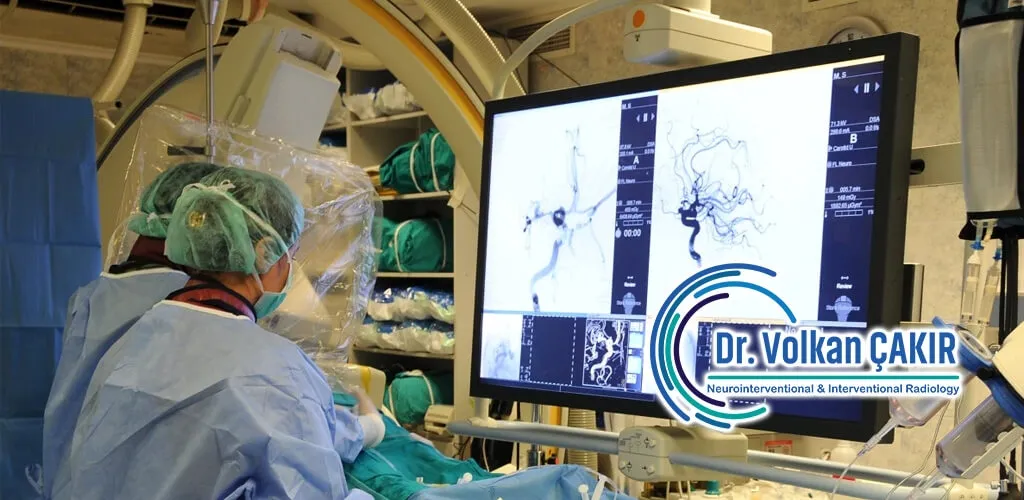
Modern medicine has transformed the way complex neurological conditions are treated. Today, many diseases affecting the brain, spine, and blood vessels of the nervous system can be managed without open surgery. Interventional neuroradiology, a specialized branch of Interventional Radiology Treatment, uses cutting-edge imaging technology and minimally invasive procedures to diagnose and treat serious neurological conditions safely and effectively.
For international patients seeking advanced care, an experienced Interventional Radiology Specialist can offer innovative image-guided treatment options that reduce surgical risks, shorten hospital stays, and improve recovery outcomes.
This comprehensive guide explains what interventional neuroradiology is, which conditions it treats, and why many patients choose these minimally invasive treatments over traditional surgery.
Interventional radiology (IR) is a medical specialty that performs treatments using real-time imaging guidance instead of traditional open surgery. Highly trained physicians known as Interventional Radiology Doctors use advanced imaging techniques such as:
Digital Subtraction Angiography (DSA)
Computed Tomography (CT)
Magnetic Resonance Imaging (MRI)
Ultrasound
Fluoroscopy
These imaging technologies allow doctors to see inside the body in real time and guide tiny instruments through blood vessels or small incisions to reach the treatment area.
Unlike conventional surgery, Interventional Radiology Treatment relies on minimally invasive procedures, which typically involve:
Small skin punctures instead of large incisions
Catheters (thin flexible tubes) inserted through blood vessels
Precise image-guided treatment to target disease directly
Reduced damage to surrounding tissues
Because of these advantages, interventional radiology has become a preferred treatment option for many complex conditions.
Interventional neuroradiology is a specialized field within interventional radiology focused on treating diseases of the:
Brain
Spinal cord
Head and neck
Blood vessels of the nervous system
An Interventional Radiology Specialist trained in neuroradiology performs advanced image-guided treatments to address neurological conditions that once required open brain surgery.
Using highly detailed imaging technologies such as angiography (DSA), CT scans, and MRI, the Interventional Radiology Doctor can precisely navigate blood vessels inside the brain and spine. Through these vessels, they deliver treatments like coils, stents, or embolization agents to repair abnormal vessels or stop bleeding.
Interventional neuroradiology requires years of specialized training in:
Neurovascular anatomy
Advanced imaging techniques
Catheter-based procedures
Stroke treatment
Complex brain vascular disorders
These specialists work closely with neurologists, neurosurgeons, and critical care teams to provide comprehensive patient care.
Interventional neuroradiology plays a crucial role in the diagnosis and treatment of many serious neurological conditions. Through minimally invasive procedures, doctors can treat vascular disorders in the brain and spinal cord that may otherwise require major surgery.
Stroke occurs when blood flow to the brain is blocked by a clot. Rapid treatment is essential to prevent permanent brain damage.
An Interventional Radiology Doctor may perform mechanical thrombectomy, a procedure where a catheter is guided through an artery to remove the clot and restore blood flow.
Benefits include:
Rapid restoration of circulation
Reduced risk of permanent disability
Improved survival rates
A brain aneurysm is a bulging or ballooning in a blood vessel wall. If it ruptures, it can cause life-threatening bleeding in the brain.
Interventional neuroradiology offers treatments such as:
Endovascular coiling
Flow diverter stents
Stent-assisted coiling
These image-guided treatments strengthen the vessel wall and prevent rupture without open brain surgery.
An AVM is an abnormal tangle of blood vessels in the brain that disrupts normal blood flow.
An Interventional Radiology Specialist can perform embolization, where special materials are injected through a catheter to block abnormal vessels.
This reduces the risk of:
Brain hemorrhage
Seizures
Neurological damage
Narrowing of brain arteries can reduce blood supply and increase stroke risk.
Treatment may include:
Balloon angioplasty
Intracranial stent placement
These procedures restore blood flow and help prevent future strokes.
Some brain or spinal tumors have a rich blood supply, which can make surgery risky.
Interventional radiologists may perform preoperative embolization, which blocks the tumor's blood supply before surgical removal. This reduces bleeding during surgery and improves surgical safety.
Interventional neuroradiology can also treat vascular conditions affecting the spinal cord, including:
Spinal AVMs
Dural arteriovenous fistulas
Spinal vascular malformations
These conditions can cause pain, weakness, or neurological deficits if untreated.
One of the main reasons patients choose Interventional Radiology Treatment is the significant benefits compared to traditional surgery.
Most procedures require only a small puncture in the skin, typically in the groin or wrist.
This means:
No large surgical incisions
Less trauma to the body
Minimal scarring
Patients undergoing image-guided treatment often recover much faster than those undergoing open surgery.
Typical recovery advantages include:
Shorter hospital stays
Faster return to daily activities
Reduced rehabilitation time
Because procedures are minimally invasive, patients experience:
Lower infection risk
Less blood loss
Reduced anesthesia exposure
Advanced imaging allows the Interventional Radiology Doctor to treat disease with exceptional accuracy, targeting only the affected area while protecting healthy tissue.
Patients usually experience:
Less pain
Reduced surgical stress
Quicker return to normal life
For many neurological conditions, these benefits make interventional neuroradiology the preferred treatment option.
Interventional neuroradiology includes several highly specialized minimally invasive procedures designed to treat different neurological conditions.
Used to treat brain aneurysms, this procedure involves inserting tiny platinum coils into the aneurysm to prevent rupture.
A life-saving procedure used in stroke treatment where a clot is physically removed from a blocked artery.
A technique used to block abnormal blood vessels or stop bleeding in conditions such as:
AVMs
Tumors
Vascular malformations
Stents are small mesh tubes placed inside arteries to keep them open and maintain proper blood flow.
A small balloon is inflated inside a narrowed artery to widen the vessel and improve circulation.
All of these procedures rely on image-guided treatment, ensuring the highest level of accuracy and safety.
Choosing the right medical center is critical when seeking advanced neurological care. Our clinic offers comprehensive Interventional Radiology Treatment designed for both local and international patients.
Our team includes highly trained Interventional Radiology Doctors with extensive experience in neurovascular procedures.
We utilize state-of-the-art equipment including:
High-resolution angiography systems
Advanced MRI and CT imaging
Real-time navigation technology
These tools allow us to deliver highly precise image-guided treatment.
We focus on personalized treatment plans designed to meet each patient’s specific medical needs.
Our approach includes:
Comprehensive diagnostic evaluation
Multidisciplinary collaboration
Detailed patient education
We support international patients with:
Medical consultations and second opinions
Treatment planning before travel
Language support and care coordination
Our goal is to provide world-class care in a safe and supportive environment.
Understanding the treatment process can help patients feel more confident about their care.
Patients typically undergo:
Imaging tests (MRI, CT, angiography)
Medical evaluation
Pre-procedure instructions
The Interventional Radiology Specialist will:
Insert a small catheter into a blood vessel.
Guide it to the treatment area using imaging.
Perform the required procedure (coiling, thrombectomy, stent placement, etc.).
Most procedures are performed under local anesthesia or mild sedation.
Recovery usually includes:
Short monitoring period
Minimal discomfort
Early return to normal activities
Many patients can go home within one or two days depending on the procedure.
Yes. When performed by an experienced Interventional Radiology Doctor, these procedures are generally very safe. They are designed to minimize risks compared to traditional surgery.
Most minimally invasive procedures cause little to no pain. Patients typically receive local anesthesia and sedation to ensure comfort during treatment.
Recovery times vary depending on the condition treated, but many patients recover significantly faster than with open surgery.
Patients with vascular conditions of the brain or spine, such as aneurysms, stroke, or AVMs, may be candidates. A consultation with an Interventional Radiology Specialist is required to determine the best treatment approach.
In many cases, image-guided treatment offers safer and faster recovery than traditional surgery. However, the best treatment depends on the patient’s condition.
Interventional neuroradiology represents one of the most advanced fields in modern medicine. By combining cutting-edge imaging technology with minimally invasive procedures, Interventional Radiology Specialists can diagnose and treat complex neurological conditions with remarkable precision.
From stroke treatment to aneurysm repair, Interventional Radiology Treatment offers safer, faster, and more effective solutions for patients worldwide.
If you or a loved one is facing a neurological condition, consulting with an experienced Interventional Radiology Doctor can help you explore innovative image-guided treatment options that may significantly improve outcomes and quality of life.
 Questions and Answers<
Interventional Radiology (IR) is a medical specialty that uses minimally invasive imaging techniques, such as X-rays, CT scans, and ultrasound, to guide procedures. These procedures can treat a wide range of conditions, such as cancer, cardiovascular disease, and certain infections, without the need for traditional surgery.
Interventional Neuroradiology (INR) is a subspecialty of radiology that focuses on the diagnosis and treatment of conditions affecting the brain, spine, and neck using minimally invasive techniques. Procedures in INR are guided by advanced imaging techniques such as angiography, CT, and MRI.