

Dr. Volkan Çakır is a highly experienced Specialist in Interventional Radiology with over 15 years of experience. He completed his medical education at Dokuz Eylül University, School of Medicine, and further specialized in radiology. Dr. Çakır has held prominent positions such as Head of the Interventional Radiology Department and Associate Professor at reputed institutions in Turkey.
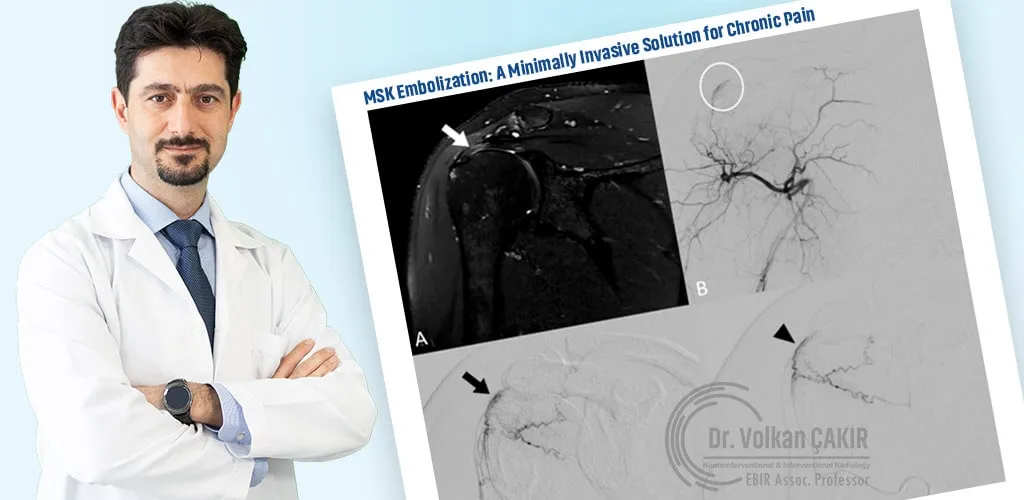
Chronic musculoskeletal pain can gradually limit mobility, reduce performance, and negatively affect overall quality of life. Conditions such as knee osteoarthritis, frozen shoulder, and chronic tendinopathies often persist despite medication, physiotherapy, or injections.
MSK (Musculoskeletal) Embolization is an advanced, image-guided, minimally invasive procedure designed to relieve chronic joint and tendon pain by targeting inflammation at its source — without the need for open surgery.
MSK embolization is a specialized interventional radiology procedure performed under advanced imaging guidance. It focuses on reducing abnormal blood vessel growth (neovascularization) that develops in chronically inflamed tissues and contributes to persistent pain.
Using a microcatheter inserted through a tiny skin puncture, microscopic embolic particles are precisely delivered to the small abnormal vessels feeding the inflamed area. By decreasing this pathologic blood flow, inflammation is reduced and pain symptoms often significantly improve.
The procedure is performed under local anesthesia and typically takes less than one hour.
MSK embolization is increasingly used worldwide for patients who have not responded adequately to conservative therapies. Common indications include:
Knee osteoarthritis (chronic knee pain)
Adhesive capsulitis (frozen shoulder)
Chronic shoulder pain
Tennis elbow (lateral epicondylitis)
Golfer’s elbow
Chronic Achilles tendinopathy
Persistent joint inflammation resistant to injections or physiotherapy
It may be particularly beneficial for patients seeking non-surgical alternatives or those wishing to delay joint replacement surgery.
Patients often choose MSK embolization because it offers several important advantages:
No major surgery
No general anesthesia
Minimally invasive technique
Short recovery time
Same-day discharge
Quick return to daily activities
Most patients resume light activities within a few days, depending on the treated area.
Interventional radiology procedures are performed using real-time imaging such as fluoroscopy and angiography, allowing precise targeting of abnormal vessels while preserving healthy tissue. This targeted approach reduces procedural risk and enhances recovery compared to traditional surgical methods.
MSK embolization represents a shift toward precision-based, minimally invasive pain management — addressing the biological cause of inflammation rather than only masking symptoms.
If chronic knee, shoulder, or tendon pain is limiting your mobility and affecting your daily life, MSK embolization may be an effective treatment option. A thorough clinical evaluation and imaging assessment are essential to determine candidacy.
For consultation and further information:
Dr. Volkan Çakır
Associate Professor, EBIR
Neurointerventional & Interventional Radiologist
 Questions and Answers<
Interventional Radiology (IR) is a medical specialty that uses minimally invasive imaging techniques, such as X-rays, CT scans, and ultrasound, to guide procedures. These procedures can treat a wide range of conditions, such as cancer, cardiovascular disease, and certain infections, without the need for traditional surgery.
Interventional Neuroradiology (INR) is a subspecialty of radiology that focuses on the diagnosis and treatment of conditions affecting the brain, spine, and neck using minimally invasive techniques. Procedures in INR are guided by advanced imaging techniques such as angiography, CT, and MRI.