

Dr. Volkan Çakır is a highly experienced Specialist in Interventional Radiology with over 15 years of experience. He completed his medical education at Dokuz Eylül University, School of Medicine, and further specialized in radiology. Dr. Çakır has held prominent positions such as Head of the Interventional Radiology Department and Associate Professor at reputed institutions in Turkey.
A Modern, Minimally Invasive Strategy for Stroke Prevention
Carotid artery stenosis is a serious vascular condition caused by narrowing of the carotid arteries—the main blood vessels supplying oxygenated blood to the brain. This narrowing most commonly results from atherosclerotic plaque buildup and significantly increases the risk of transient ischemic attack (TIA) and ischemic stroke. Importantly, carotid artery disease may progress silently, even in patients without obvious neurological symptoms.
Early diagnosis and timely intervention are therefore critical to prevent irreversible neurological damage and preserve long-term brain health.
Why Is Carotid Artery Stenosis Dangerous?
The carotid arteries play a vital role in maintaining normal brain function. Any reduction in cerebral blood flow can impair speech, movement, memory, and cognitive performance. In addition, unstable plaque within the carotid artery may release embolic material, leading to sudden and potentially devastating stroke.
Clinical studies have clearly shown that patients with moderate to severe carotid artery narrowing carry a substantially increased risk of stroke. For selected patients, preventive intervention is strongly recommended to reduce this risk and improve long-term neurological outcomes.
What Is Endovascular Treatment for Carotid Artery Stenosis?
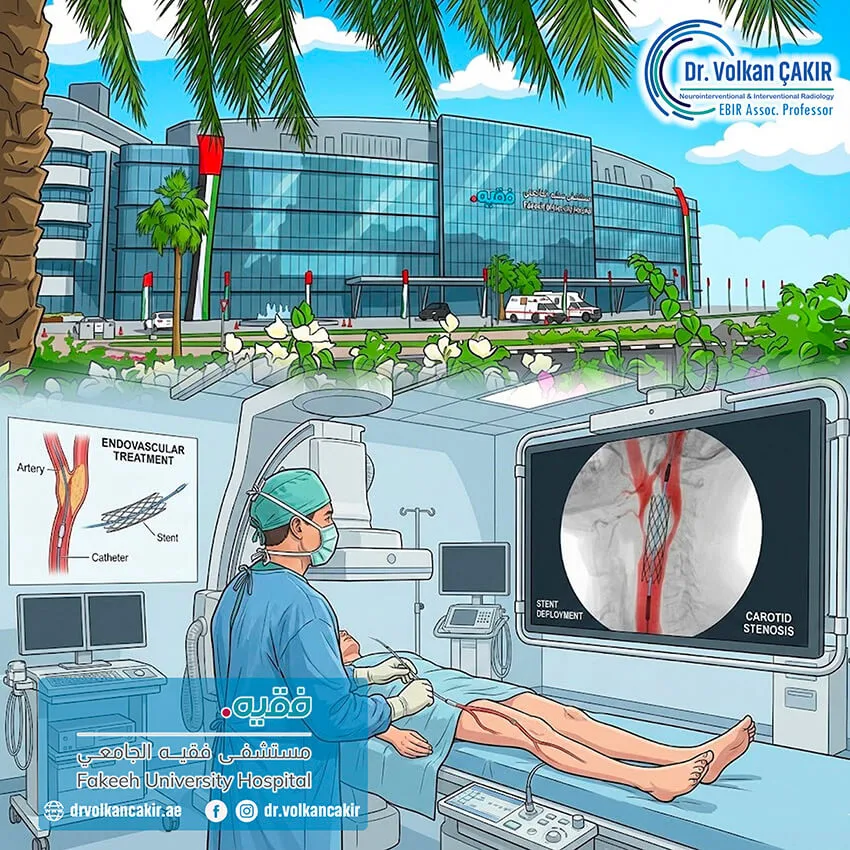
Endovascular treatment is a minimally invasive, catheter-based procedure designed to restore adequate blood flow to the brain without the need for open surgery.
Through a small vascular access—usually via the groin or wrist—advanced imaging guidance is used to navigate safely to the diseased segment of the carotid artery. The narrowed area is gently widened using balloon angioplasty, and in most cases, a carotid stent is deployed to support the arterial wall and maintain long-term patency.
This technique stabilizes the plaque, improves cerebral perfusion, and significantly reduces the risk of future stroke.
Advantages Compared to Open Surgery
When compared with carotid endarterectomy (open surgical plaque removal), endovascular treatment offers several important advantages, particularly for patients considered at higher surgical risk.
Key benefits include:
For these reasons, endovascular therapy has become an essential component of modern stroke prevention strategies.
Individualized, Technology-Driven Treatment Planning
Each patient undergoes a comprehensive evaluation to determine the most appropriate treatment strategy. Careful procedural planning is based on:
This personalized approach maximizes procedural safety while optimizing long-term clinical outcomes.
A Long-Term Focus on Brain Health
The primary goal of carotid artery intervention is not only to treat existing vascular disease but also to prevent future neurological events. By restoring stable blood flow and reducing embolic risk, endovascular treatment plays a crucial role in preserving cognitive function and quality of life.
Long-term follow-up, risk factor modification, and preventive strategies remain integral parts of comprehensive cerebrovascular care.
Schedule a Consultation
If you or a loved one has been diagnosed with carotid artery stenosis—or if you are seeking expert evaluation for stroke prevention—early consultation is essential. Timely intervention can make a life-changing difference.
 Questions and Answers<

Interventional Radiology (IR) is a medical specialty that uses minimally invasive imaging techniques, such as X-rays, CT scans, and ultrasound, to guide procedures. These procedures can treat a wide range of conditions, such as cancer, cardiovascular disease, and certain infections, without the need for traditional surgery.
Interventional Neuroradiology (INR) is a subspecialty of radiology that focuses on the diagnosis and treatment of conditions affecting the brain, spine, and neck using minimally invasive techniques. Procedures in INR are guided by advanced imaging techniques such as angiography, CT, and MRI.